In order to bring a better focus on its key markets and improve the high levels of service it already delivers to its customers, AJ Tensile Fabrications Limited has been divided into AJ Tensile Biogas Systems Limited, AJ Tensile Tension Structures Limited, and AJ Tensile Manufacturing Limited. These three companies all operate under the AJ Tensile Group Limited parent company umbrella.
The Biogas and Structures companies will benefit from dedicated staff with an expertise in delivering high quality projects, and will allow the skilled and experienced manufacturing staff to continue to concentrate on producing top quality products.
Biogas Systems will be headed up by Richard Cherry, one of the world’s most experienced and respected experts on anaerobic digestion and biogas storage. The Structures company will be headed up by Gary Patterson who has extensive experience of designing, project managing and installing tensile fabric structures throughout the world. Andrew Jerrum formed AJ Tensile Fabrications Ltd in 2000 and is an expert innovator of industrial fabric manufacture processes. He will head up the manufacturing operation while continuing his role of Group Managing Director.
Andrew said “the business has grown rapidly over recent years and it is increasingly evident that our staff need to become more specialised in order to continue delivering the excellent levels of products and service that our proud reputation is based on. The whole group is dedicated to making the transition as seamless as possible for all staff, customers, and suppliers”.
This website will shortly be updated to reflect these changes.
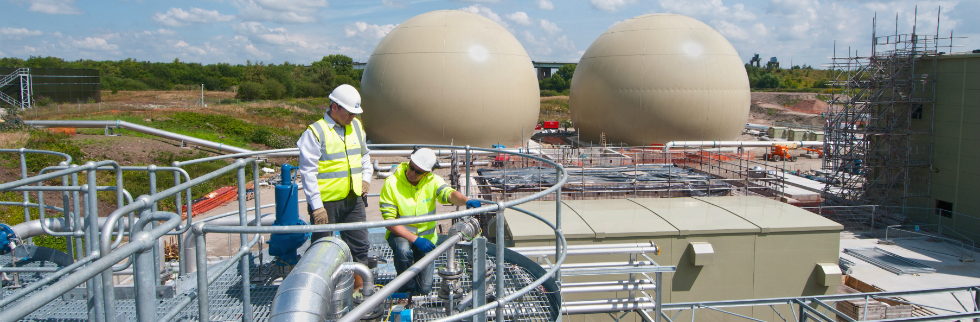
A very insightful article was recently published in Black & Veatch’s Solutions Online regarding net-zero energy production at wastewater facilities. We at AJ Tensile Fabrications manufactured the two large biogas domes at United Utilities’ flagship site at Davyhulme, Greater Manchester (shown in the main photo), with senior members of our Biogas division responsible for the design and engineering.
http://bv.com/Home/news/solutions/water/net-zero-energy-in-grasp-of-wastewater-treatment-facilities
Net-Zero Energy Is Now ‘In the Grasp’ of Wastewater Treatment Facilities
It is commonly known that wastewater possesses more energy than needed to operate a treatment facility, but the number of net-zero energy water resource recovery facilities (WRRFs) is still very low worldwide. Yet, a recent study states that the possibility of net-zero energy is now in the grasp of many wastewater facilities, and the report provides some of the best insights on record as to how to achieve such results.
The study, commissioned by the Water Environment Research Foundation (WERF), identifies approaches to reduce energy use and maximize energy production in water resource recovery facilities. The goal is to demonstrate ways wastewater treatment facilities can operate solely on the energy from the water and wastes they treat.
Stephen Tarallo, a Client Services Director for Black & Veatch’s water business, served as co-principal investigator for the project, which is titled “Net-Zero Energy Solutions For Water Resource Recovery Facilities”(ENER1C12).
“The research offers guidance for selecting the combination of technologies and energy management best practices to most effectively achieve energy neutrality at WRRFs,” Tarallo said. “We wanted to demonstrate how to maximize resource recovery through harnessing the chemical, thermal, potential and kinetic energy contained in the treated wastes.”
Real-Life Statistics and Energy Flow Models Yield Valuable Information
The study included a detailed survey of approximately 40 WRRFs in North America and Australia, which yielded valuable statistics about energy use. In addition, nine industry leaders in net-zero energy wastewater treatment were selected from the 40 WRRFs for the development of case studies to document energy management lessons learned and best practices.
According to the WERF research, energy neutrality is within the grasp of water resource recovery facilities that use the conventional activated sludge process for biochemical oxygen demand (BOD) reduction (basic secondary treatment) and nitrification. But no two facilities are alike. In fact, the research team modeled the energy flows of 25 typical WRRF configurations, ranging from basic secondary treatment to membrane bioreactors for nutrient removal and water reuse. Facility operators can use these model results to find a configuration that is similar to their plant.
The research team also investigated the energy efficiency and energy recovery performance of 18 emerging technologies and processes in a variety of treatment plant configurations. The team used combinations of best-practice and these pioneering ideas to develop 10 hypothetical model facilities that approach or exceed energy neutrality.
Best in Class of Modeled Facilities
The best overall performance was observed for a plant that consisted of chemically enhanced primary treatment (CEPT) followed by BOD-only activated sludge treatment, then anaerobic digestion, including thermal hydrolysis pre-treatment of feed sludge and co-digestion of market-available fats, oils and grease (FOG) and food waste, and combined heat and power (CHP). That facility reached an energy rating of 139 percent, meaning it met its actual energy usage plus nearly 40 percent more.
The team also developed criteria to assess the triple-bottom-line (social, environmental and financial) sustainability score of six different biosolids management options. The results showed that anaerobic digestion with co-digestion, as well as CHP followed by land-application of biosolids, had the best overall sustainability score.
For minimizing energy use, the study showed that best practices include:
- The use of clean and properly maintained fine-bubble diffusers;
- Use of high-efficiency motors and generators operating near their design point;
- Maximization of solids capture in sludge processing;
- Maximization of primary sludge capture efficiencies;
- Co-digestion of fats, oil and grease/food waste in anaerobic digesters;
- Use of anoxic zones for energy recovery in nitrification plants.
The research on energy savings showed that improving primary treatment and solids capture in thickening and dewatering processes had the most significant total positive impact of all the best practices modeled.
“We found that the full combination of best practices reduces net energy use by roughly 40 percent compared to typical performance,” Tarallo said. “This is significant and demonstrates that proven technologies already exist for WRRFs to make a significant dent in their energy use.”
A Lofty but Reachable Goal
Tarallo said net-zero energy is a lofty goal that requires detailed planning and sustained commitment.
“The main challenges are different for each utility,” Tarallo said. “I would characterize the main challenge for biological nutrient removal (BNR) and membrane bioreactor (MBR) facilities as being technical – the technologies are just not sufficiently advanced at this time to confidently achieve the goal. For conventional and nitrification WRRFs, where technologies are available and well-proven, the challenges are more organizational and financial in nature.”
He said the overriding driver for success in all cases is strong leadership – a champion for the cause.
“We had the pleasure to speak with a variety of energy management champions about their utilities’ challenges and accomplishments. The passion that all of these leaders possess is infectious.”
This article was first published in Black & Veatch’s Solutions Online and is reprinted with permission.
Date posted: 24 February 2016
Posted in:
Uncategorized
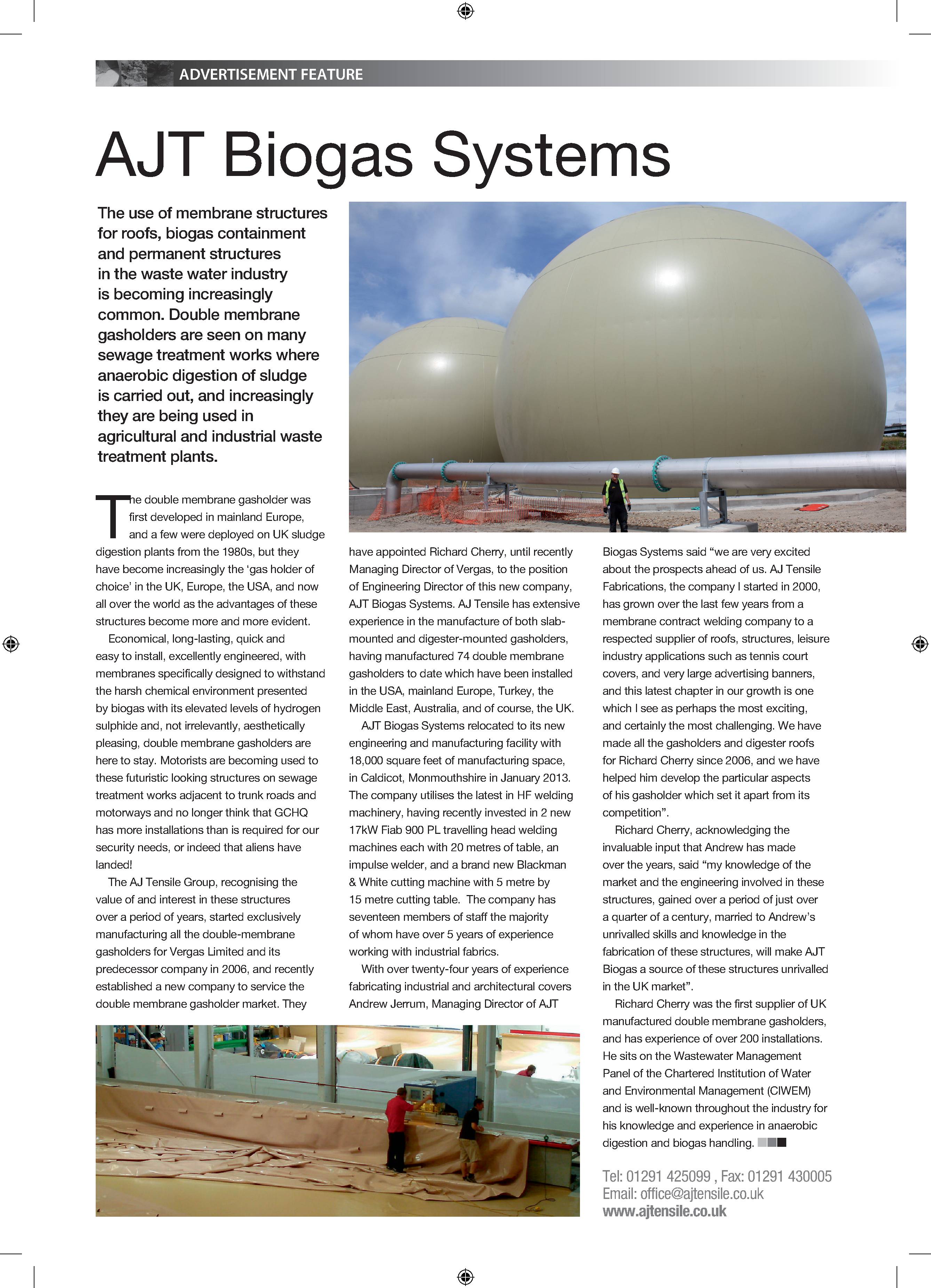
We recently came across this old press release announcing the incorporation of A J Tensile Biogas Systems, so thought we’d share it here for posterity:
AJ Tensile Biogas Systems
The use of membrane structures for roofs, biogas containment and permanent structures in the waste water industry is becoming increasingly common. Double membrane gasholders are seen on many sewage treatment works where anaerobic digestion of sludge is carried out, and are being increasingly used in agricultural and industrial waste treatment plants.
The double membrane gasholder was first developed in mainland Europe, and a few were deployed on UK sludge digestion plants from the 1980s, but they have become increasingly the ‘gas holder of choice’ in the UK, Europe, the USA, and now all over the world as the advantages of these structures become more and more evident. Economical, long-lasting, quick and easy to install, excellently engineered, with membranes specifically designed to withstand the harsh chemical environment presented by biogas with its elevated levels of hydrogen sulphide and, not irrelevantly, aesthetically pleasing, double membrane gasholders are here to stay. Motorists are becoming used to these futuristic looking structures on sewage treatment works adjacent to trunk roads and motorways and no longer think that GCHQ has more installations than is required for our security needs, or indeed that aliens have landed!
The AJ Tensile Group, recognising the value and interest in these structures over a period of years, started exclusively manufacturing all the double-membrane gasholders for Vergas Limited and its predecessor company in 2006, and recently established a new company to directly service the double membrane gasholder market. They have appointed Richard Cherry, until recently Managing Director of Vergas, to the position of Engineering Director of this new company, AJT Biogas Systems. AJ Tensile has extensive experience in the manufacture of both slab- mounted and digester-mounted gasholders, having manufactured 74 double membrane gasholders to date which have been installed in the USA, mainland Europe, Turkey, the Middle East, Australia, and of course, the UK.
AJT Biogas Systems relocated to its new engineering and manufacturing facility with 18,000 square feet of manufacturing space, in Caldicot, Monmouthshire in January 2013. The company utilises the latest in HF welding machinery, having recently invested in 2 new 17kW Fiab 900 PL travelling head welding machines each with 20 metres of table, an impulse welder, and a brand new Blackman & White cutting machine with 5 metre by 15 metre cutting table. The company has seventeen members of staff, the majority of whom have over 5 years of experience working with industrial fabrics.
With over twenty-four years of experience fabricating industrial and architectural covers Andrew Jerrum, Managing Director of AJT Biogas Systems said “We are very excited about the prospects ahead of us. AJ Tensile Fabrications, the company I started in 2000, has grown over the last few years from a membrane contract welding company to a respected supplier of roofs, structures, leisure industry applications such as tennis court covers, and very large advertising banners, and this latest chapter in our growth is one which I see as perhaps the most exciting, and certainly the most challenging. We have made all the gasholders and digester roofs for Richard Cherry since 2006, and we have helped him develop the particular aspects of his gasholder which set it apart from its competition”.
Richard Cherry, acknowledging the invaluable input that Andrew has made over the years, said “my knowledge of the market and the engineering involved in these structures, gained over a period of just over a quarter of a century, married to Andrew’s unrivalled skills and knowledge in the fabrication of these structures, will make AJT Biogas a source of these structures unrivalled in the UK market”. Richard was the first supplier of UK manufactured double membrane gasholders, and has experience of over 200 installations. He sits on the Wastewater Management Panel of the Chartered Institution of Water and Environmental Management (CIWEM) and is well known and well respected throughout the industry for his knowledge and experience in anaerobic digestion and biogas handling.
Date posted: 8 February 2016
Posted in:
Uncategorized
Click the ‘downloads’ tab at the top of the page or click the link below to download a PDF version of our Biogas brochure. The file size is 1.6MB.
Biogas Brochure 1.6MB
Date posted: 28 October 2015
Posted in:
Uncategorized
Our Tension Structures division was recently awarded Safecontractor status, giving our clients full confidence that the highest standards of site safety will be adhered to on all of our projects.

Date posted: 28 October 2015
Posted in:
Uncategorized
Following months of preparation and a thorough two-day audit our Fabrications and Biogas divisions are very proud to announce that they have been awarded Achilles Supplier Information & Supply Chain accreditation, and can now sit alongside such valued brands as Aston Martin, EDF Energy, Shell Oil and McLaren Automotive in the list of accredited supply chain members.

In their own words, “Achilles creates and manages a global network of collaborative industry communities, allowing trading partners to share high quality, structured, real-time data. Using cloud-based technology, we act as an independent partner providing validated data and insightful analytics to enable buyers to manage risk, and suppliers to increase market reach in their sector”.
Date posted: 9 March 2015
Posted in:
Uncategorized
We are pleased to announce that our Tension Structures division has now achieved full Constructionline accreditation, making pre-qualification more straightforward and helping to streamline the tendering process.
Date posted: 19 January 2015
Posted in:
Uncategorized
Our projects staff recently braved sub-zero temperatures to bring you this group photo for the start of the new year, and they’ll be offended if you don’t get it framed and prop it up on your mantelpiece.
Wishing all of you a Happy New Year and a prosperous 2015 from all of us here at AJ Tensile..!